General Sensory Afferent
The general sensory afferent carries sensory input from the skin, muscle, tendons and joints to the brain
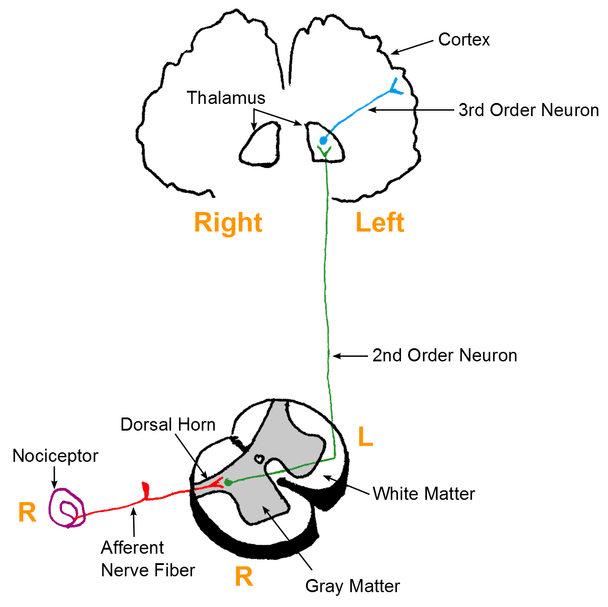
Pathway
- Sensory receptors:
Sensory receptors are specialized cells or nerve endings that detect specific kinds of stimuli from the environment or within the body and convert them into electrical signals (nerve impulses) that the nervous system can interpret.
They act as the “input devices” of the nervous system, allowing you to perceive and respond to changes inside and outside your body.
Types of sensory receptors (by stimulus detected):
-
Mechanoreceptors – respond to mechanical forces (touch, pressure, vibration, stretch, hearing, balance).
-
Thermoreceptors – detect temperature changes (heat and cold).
-
Nociceptors – detect pain from tissue damage or harmful stimuli.
-
Photoreceptors – detect light (rods and cones in the retina).
-
Chemoreceptors – respond to chemical changes (taste, smell, blood pH, O₂/CO₂ levels).
-
Proprioceptors – sense body position and movement (in muscles, tendons, joints, inner ear).
General properties:
-
Transduction: They convert a stimulus (e.g., light, sound, pressure) into an electrical signal.
-
Specificity: Each receptor is usually specialized for one type of stimulus.
-
Adaptation: Some receptors reduce their response if the stimulus is constant (e.g., you stop noticing your clothes after a while).
-
From these receptors, the signal is carried by the distal axon of the dorsal root ganglion, passed the dorsal root ganglion and to the proximal axon.
There is no synapse!
2.. First Order Neuron (Dorsal Root Ganglion
The first-order neuron has its cell body in the dorsal root ganglion of the spinal nerve. It is a type of pseudounipolar neuron. It has a peripheral axon which transmits signal from receptors and a central axon synapsing on the second-order neuron.
In the head or neck not covered by the cervical nerves, the first-order neuron will be the trigeminal nerve ganglia or the ganglia of other sensory cranial nerves).
3. The second-order neuron has its cell body either in the spinal cord or in the brainstem.
4. This neuron's ascending axons will cross (decussate) to the opposite side either in the spinal cord or in the brainstem.
5. The third-order neuron has its cell body in the ventral posterior nucleus of the thalamus and ends in the postcentral gyrus of the parietal lobe in the primary somatosensory cortex.